Fragility & Resilience
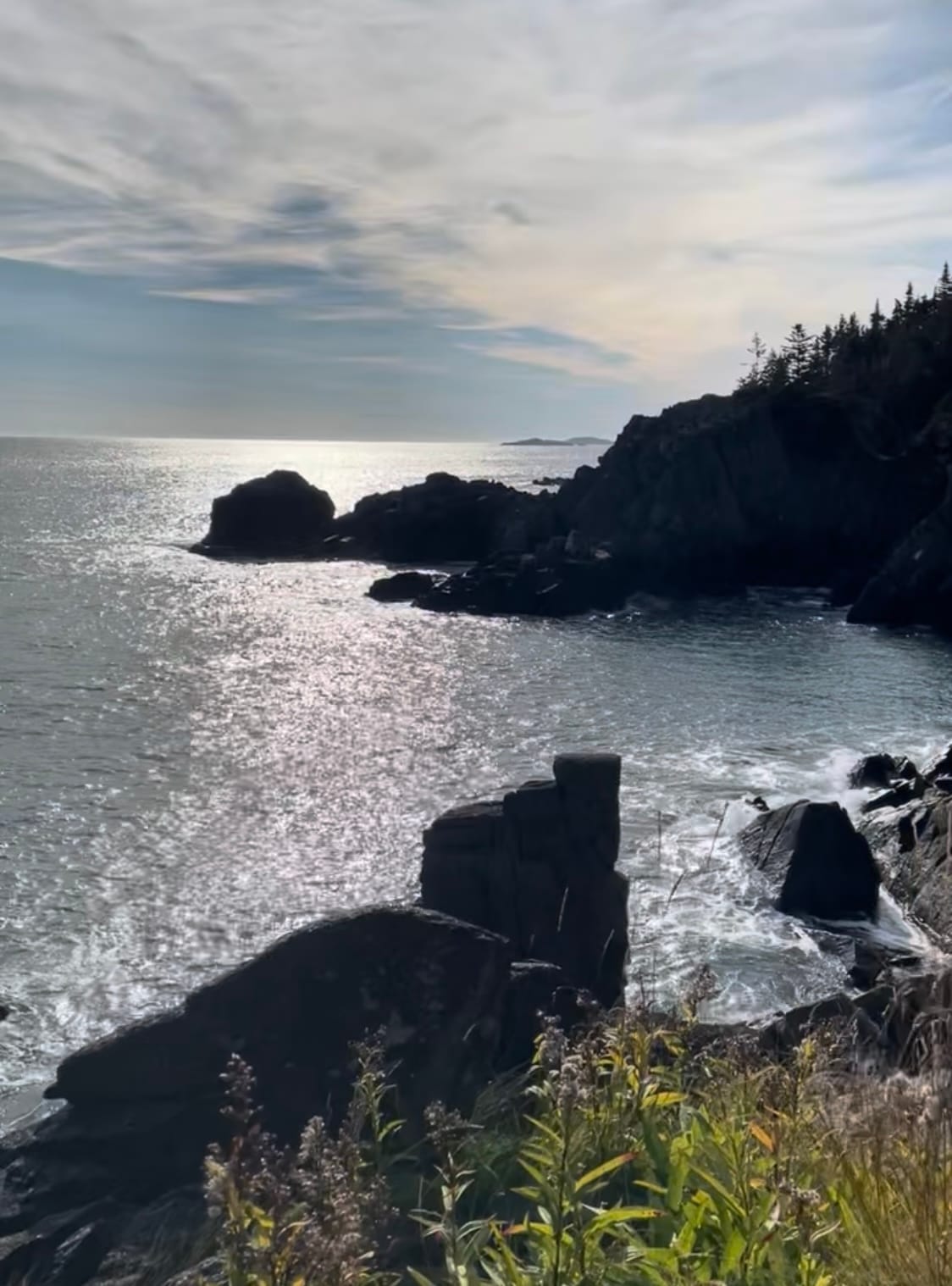
On Sunday, October 20, 2024, I sat on a rock listening to the waves rush against the rocky point of Western Head in Cutler. I couldn’t help but be grateful to be in this wild and beautiful place. The waves rushed back and forth in their never-ending dance with the shore and yet somehow their hurry called me to stillness. Unfortunately, my hiking companion has not yet learned to sit still and enjoy the scenery. His whines and barks soon pulled me back to the trail where I was met by several others meandering along the rocks, enjoying the view.
All was going well until I took a misstep on an exposed tree root and crumpled as my ankle turned out with an audible crack. I was uncertain at first if I would be able to get back up as I took a few seconds to breathe through the initial intense pain. But, aware of the approaching hikers I’d met earlier who were now making their way down the trail towards the rocky beach I was sitting on the edge of, I hurried to stand. Partly I wanted to avoid the embarrassment of being found sprawled on the ground, but also I wanted to make sure my ankle would bear my weight, in case I needed to enlist their help. Though very tender and swelling rapidly, my ankle did indeed hold my weight. By walking short, slow, flat-footed steps I was able to progress. I was a mile away from the car, but short of a rescue by boat (which seemed extreme), I had no other way out of these woods. And so I limped my way back, increasing my trail time by much more than anticipated.
As I took slow, careful and often painful steps, I realized that even this injury was failing to change the way that I felt about this glorious day. The reflection I had started internally at the top of the Head was reinforced and expanded. My overwhelming feelings were of strength and resilience and the mantras of “I am strong; I am resilient” mingled with the occasional swears and sharp intakes of breath.
It had been less than a month since my doctor had begrudingly given me the “working diagnosis” of fibromyalgia. Somehow that diagnosis made me feel weak in a way that the rheumatoid arthritis we had been worried about did not. Reading through online medical resources as I processed this news I came across one sentence that I couldn’t shake. The sentence briefly mentioned one theory—that people with fibromyalgia may be more sensitive to pain. This one little piece of info that I don’t even know the factual evidence for sent me in a downward spiral. If I’m more sensitive to pain, wouldn’t that mean that the everyday pain I’m experiencing could be rather normal and I just notice it more than anyone else? Wouldn’t this mean that “it’s all in my head?” Ironically, the feeling that it is all in your head was also mentioned as a common symptom of fibromyalgia. Of course this makes sense when medical experts are basically saying “We don’t really understand what is causing your symptoms. . . ”
Anyway, my mind had been bogged down by that mess of thoughts, and getting out to hike was helping me remember how strong and capable my body can be. I felt motivated to get out and do more, and to take charge of my choices in order to create more space to do the things I love. I was empowered. And ironically, spraining my ankle and limping that whole mile back to the car only bolstered that resolve. I am strong. I am resilient. I am capable. And if I can hike a mile on a sprained ankle, then I am definitely not overly sensitive to pain.